
Short bed or standard bed: which one is right for you?
August 28 2026,
Summary
- What truck bed sizes are available on Chevrolet and GMC trucks?
- Short bed vs. standard bed: how much space do you actually gain?
- What can you actually carry in a short bed vs. a standard bed?
- Short bed or standard bed: what difference does it make in everyday driving?
- Short bed vs. standard bed for work: which one is more practical?
- ATV, snowmobile and recreational equipment: which bed should you choose?
- Does bed length affect payload or towing capacity?
- Family and everyday use: which bed fits your lifestyle best?
- Cab-and-bed combinations and what they really change
- Can you make a short bed more versatile?
- Short box or standard box: the final comparison
- Still not sure? The Paillé GM team can help you choose
- FAQ: Short Bed vs. Standard Bed
Summary
- What truck bed sizes are available on Chevrolet and GMC trucks?
- Short bed vs. standard bed: how much space do you actually gain?
- What can you actually carry in a short bed vs. a standard bed?
- Short bed or standard bed: what difference does it make in everyday driving?
- Short bed vs. standard bed for work: which one is more practical?
- ATV, snowmobile and recreational equipment: which bed should you choose?
- Does bed length affect payload or towing capacity?
- Family and everyday use: which bed fits your lifestyle best?
- Cab-and-bed combinations and what they really change
- Can you make a short bed more versatile?
- Short box or standard box: the final comparison
- Still not sure? The Paillé GM team can help you choose
- FAQ: Short Bed vs. Standard Bed
Short bed vs standard bed may seem like a minor consideration when shopping for a Chevrolet Silverado 1500 or GMC Sierra 1500. But it’s a difference you’ll notice every time you use your truck.
A short bed is easier to live with day to day. A standard bed gives you more room when you need to haul gear, equipment or longer items. And when you compare truck box sizes and measurements, those extra inches can make a noticeable difference in the truck’s overall length.
On the Silverado 1500 and Sierra 1500, the short bed measures 5’10” (69.9 in.), the standard bed 6’7” (79.4 in.), and the long bed 8’2” (98.2 in.). But is that extra bed space worth having a longer truck overall?
It really comes down to what you carry and how you actually use your truck.
What truck bed sizes are available on Chevrolet and GMC trucks?
Truck box lengths vary across the Chevrolet and GMC lineups. Each truck category has its own configurations, and some models don’t even give you a choice.
Chevrolet Silverado 1500 and GMC Sierra 1500 bed dimensions
Three bed lengths are available, with the same dimensions for both trucks:
- Short bed: 5’8” (69.9 in. / 1,776 mm)
- Standard bed: 6’6” (79.4 in. / 2,018 mm)
- Long bed: 8’2” (98.2 in. / 2,494 mm)
There’s a 28.3 inch difference between the shortest and longest beds (nearly 2’4”).
That may sound abstract on paper, but it’s roughly the length of a recycling bin added to the back of your truck every time you park, turn into a driveway or back into a tight space.
Chevrolet Silverado HD and GMC Sierra HD bed dimensions
On the 2500 and 3500, the choice comes down to two box lengths, again with the same dimensions for both makes:
- Standard bed: 6’9” (82.25 in. / 2,089 mm )
- Long bed: 8’2” (98.27 in. / 2,496 mm)
These trucks are built with work in mind, so there’s less compromise when it comes to cargo space, whether you’re hauling job-site materials or loading an ATV with the tailgate closed.
Chevrolet Colorado and GMC Canyon bed dimensions
Here, there’s no decision to make. In Canada, the Colorado and Canyon are offered in a single configuration: Crew Cab with a short bed.
If you’re shopping in this category and need a longer bed, you’ll have to move up to a half-ton truck.
Pro tip :
“Since 2023, midsize trucks have only been offered in one configuration, with the Crew Cab and 5-foot-2 bed. That can definitely influence the decision for some buyers.
You also have to keep in mind that the Crew Cab here is smaller than the one you get in a 1500. So if you have a family, you may prefer a 1500 just for the cab. The back seat practically feels like a living room compared with what you get in a midsize truck.”
— Alexandre Rivest, Sales Consultant
Short bed vs. standard bed: how much space do you actually gain?
On the Silverado 1500 and Sierra 1500, the box lengths break down as follows:
- Short bed: 5’8” ( 69.9 in. / 1,776 mm)
- Standard bed: 6’6” (79.4 in. / 2,018 mm)
- Long bed: 8’2” (98.2 in. / 2,494 mm)
On the Silverado HD and Sierra HD, there are only two sizes:
- Standard bed: 6’9” (82.25 in. / 2,089 mm)
- Long bed: 8’2” (98.27 in. / 2,496 mm)
But what determines whether your truck fits in the garage isn’t the bed alone. It’s the truck’s overall length, which depends on the cab-and-bed combination.
| Configuration | Overall length | Wheelbase |
|---|---|---|
| Crew Cab, short bed | 19’4” (233 in. / 5,912 mm) | 12’3” (148 in. / 3,748 mm) |
| Double Cab, standard bed | 19’3” (232 in. / 5,890 mm) |
12’3” (147 in. / 3,746 mm ) |
Here’s something that surprises a lot of people: a Crew Cab with a short bed isn’t actually shorter than a Double Cab with a standard bed. In fact, it’s slightly longer.
The real difference isn’t the truck’s overall length. It’s where that length goes: more passenger room with one configuration, more bed space with the other.
That’s where talking to a Paillé expert can really help. We’ll walk you through the different configurations so you can leave with a truck that actually fits your needs.
What can you actually carry in a short bed vs. a standard bed?
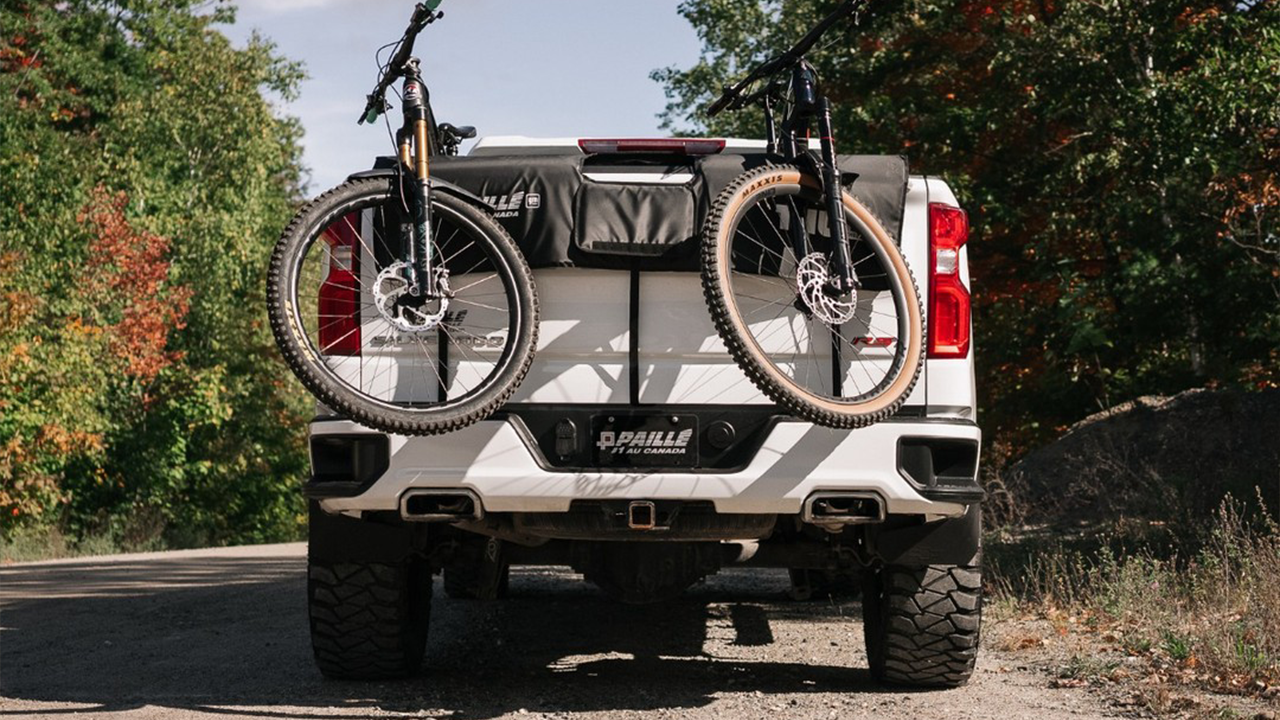
A 4 x 8 sheet of plywood can fit flat between the wheel wells even with a short bed. The difference between the two is that the tailgate has to stay down. With a standard bed, you can close the tailgate.
For an ATV, a short bed works in many cases. With some longer models, the rear wheels may sit on the open tailgate, but your ATV can still be transported once properly secured. A standard bed gives you more room and may allow your ATV to fit with the tailgate closed.
On Crew Cab models, the Multi-Flex tailgate from Chevrolet (or MultiPro from GMC) is also a game changer. Available starting with the LT trim at Chevrolet, and standard on nearly every Sierra trim, this multi-position tailgate adds a load stop, an inner panel that doubles as a work surface, and two-tier bed access. A real advantage, no matter which bed length you choose.
A motorcycle fits easily in either bed length.
For longer materials, such as boards or pipes over eight feet, neither bed will contain the entire load without some overhang.
The amount of overhang isn’t the same, though. The shorter the bed, the farther the load extends beyond the truck, which can affect load stability, visibility and potentially the signalling requirements for an overhanging load in Quebec.
The decision really comes down to how often you need the extra length. If you rarely haul anything longer than six feet, a short bed may be all you need. If closing the tailgate and having that extra space matter to you every week, the standard bed becomes a real advantage rather than a luxury.
Short bed or standard bed: what difference does it make in everyday driving?
Chevrolet and GMC don’t publish an exact turning radius for every configuration. But the basic principle remains: a shorter wheelbase generally makes a truck easier to manoeuvre, especially in tight spaces.
A Crew Cab with a short box has a different wheelbase than other cab-and-bed configurations, even when their overall lengths are very similar.
You notice it most when manoeuvring: pulling into an underground parking space in downtown Montreal or Quebec City, turning into a narrow alley or backing into a residential garage without having to make three attempts.
In rural areas, that difference may matter less. Driveways tend to be larger, parking lots less crowded and streets less confined. It’s in the city, in traffic and in tighter spaces that every inch begins to count.
If the short bed is starting to sound like the better fit, we’ve broken down 6 reasons to choose a short bed in more detail.
Short bed vs. standard bed for work: which one is more practical?
For a contractor, electrician, plumber or landscaper, a standard bed can make a lot of sense. You get more room and more length for pipes, lumber, steel bars and other materials, with less overhang to deal with every day.
Payload capacity isn’t determined by bed length alone. It depends on the engine, cab and overall truck configuration. In some configurations, a shorter bed may even contribute to a slightly higher available payload because the truck itself is lighter.
For someone carrying boxes, tools or smaller equipment, a short bed may provide more than enough room. The real issue isn’t always weight — It’s space. Eight-foot lumber doesn’t get any shorter just because your truck has more payload capacity.
So ask yourself one simple question: what do you carry most often … bulky or long items, or heavy items?
And if you're curious to learn more about the types of advantages GM offers over its competitors, let’s look at the actual cargo volume in the box. This relates to the way the bed's structure itself was designed: for a bed of the same length in a GM versus Ford truck, for example, the GM bed will always be larger in volume than the Ford bed.
Here are some numbers: for the short bed, GM gives you 62.9 cu. ft., while Ford offers you 62.3 cu. ft. So even though both are short beds, GM simply gives you more.
ATV, snowmobile and recreational equipment: which bed should you choose?
For your ATV, a short bed works in many cases. Some longer ATVs may end up with their rear wheels on the open tailgate, but they can still be transported once they’re properly secured. A standard bed gives you additional length and may allow the tailgate to close.
For your snowmobile, even a long bed generally isn’t enough on its own. Snowmobiles are commonly around 100 to 130 inches long, compared with roughly 98 inches for a long bed. A sled deck or another suitable loading system is therefore typically required.
The longer the bed, the less the snowmobile extends behind the truck, which can also affect signalling requirements for an overhanging load.
For two snowmobiles, or if you head out regularly, a trailer will usually be the more practical solution regardless of bed length.
Does bed length affect payload or towing capacity?
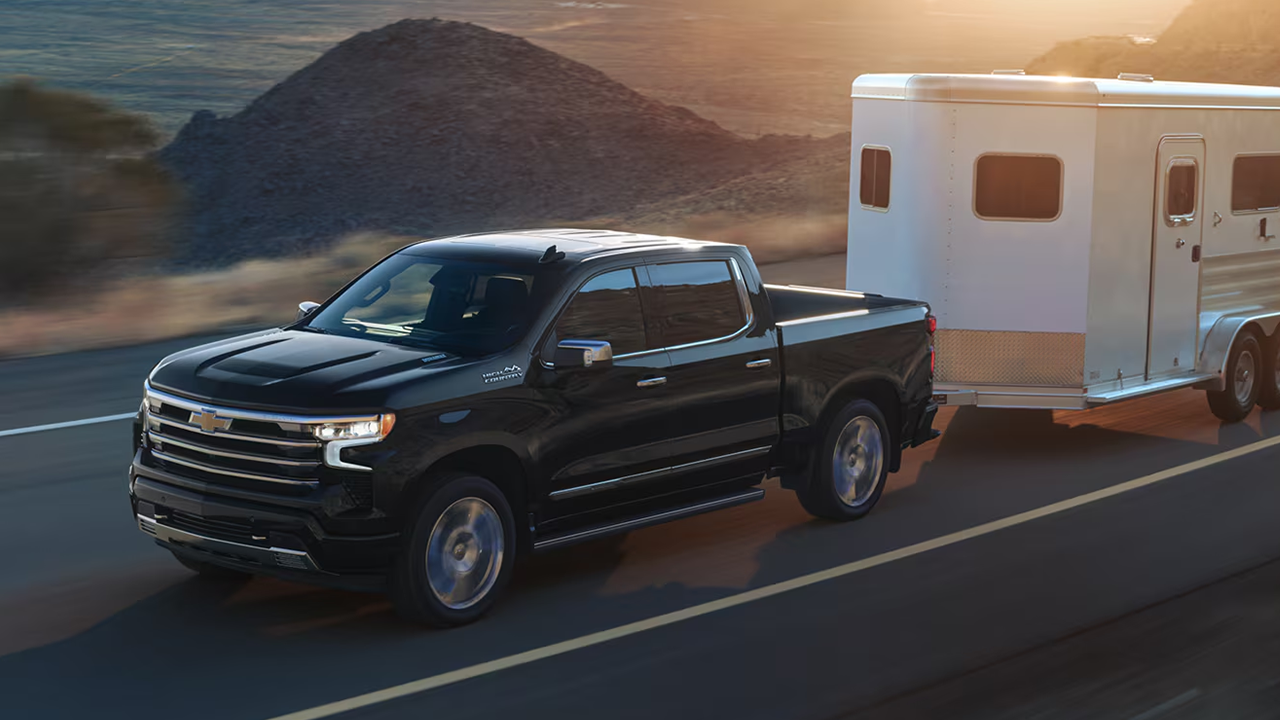
Bed length alone doesn’t determine payload or towing capacity. Engine, axle ratio, cab, drivetrain and the truck’s complete configuration all play a role.
That means two trucks with the same engine can still have different ratings depending on how they’re configured.
Wheelbase can also affect how a truck feels while towing. A longer wheelbase can provide a different sense of stability with a heavy trailer, particularly at highway speeds.
The important thing is to check the ratings for the specific truck configuration you’re considering rather than assuming that a longer or shorter bed automatically means greater towing capability.
Family and everyday use: which bed fits your lifestyle best?
A Crew Cab with a short bed is a popular family-friendly combination: four full-size doors, a full rear bench and a more compact overall package than the same cab with a longer bed.
This configuration measures 19’4” (233 in. / 5,912 mm ), almost the same as a Double Cab with a standard bed at 19’3” (232 in. / 5,890 mm).
So the advantage isn’t necessarily overall vehicle length. It’s passenger space.
For families that regularly carry sports equipment, camping gear or renovation supplies, a Crew Cab with a standard bed adds room for cargo without sacrificing rear-seat space. The trade-off is a longer truck that can be more challenging to manoeuvre.
Cab-and-bed combinations and what they really change
One thing to keep in mind is that you can’t combine just any cab with any bed. Each truck has its own available configurations, and they can even differ between the 2500 and 3500.
Silverado 1500 and
Sierra 1500
- Regular Cab: standard or long bed
- Double Cab: standard bed only
- Crew Cab : short or standard bed
Silverado 2500 HD and
Sierra 2500 HD
- Regular Cab : long bed only
- Double Cab : standard or long bed
- Crew Cab : standard or long bed
Silverado 3500 HD and
Sierra 3500 HD
- Regular Cab : long bed only
- Double Cab : long bed only
- Crew Cab : standard or long bed
Availability can also vary by trim. On the Silverado 1500, for example, certain cab-and-bed combinations are only available on specific trims and drivetrains.
Before shopping for a very specific configuration, it’s worth confirming with a Paillé expert that it’s actually available on the trim you're interested in.
For the 1500, here’s what those choices mean in practical terms:
| Combination | Overall length | What it prioritizes |
|---|---|---|
| Crew Cab, short bed | 19’4” (233 in. / 5,912 mm) | Passenger space |
| Double Cab, standard bed | 19’3” (232 in. / 5,890 mm) | Balance of passenger and cargo space |
| Regular Cab, standard or long bed | 211 to 242 inches | Cargo space (bed) |
Two trucks with nearly identical overall lengths can feel completely different depending on where the space is used: inside the cab or in the box.
Can you make a short bed more versatile?
Yes, and not just with aftermarket accessories. The Multi-Flex and MultiPro tailgates, available on Crew Cab models, already add factory-built versatility: a work surface, a second loading level, and built-in load stops. Beyond that, a bed cover, a tie-down system, or a hitch-mounted cargo carrier remain good solutions for occasional needs.
There is one precaution, though. Modifications that alter original equipment can affect warranty coverage for the components involved. Chevrolet or GMC accessories designed for your truck and properly installed that are a safer way to make sure everything works together as intended.
Come talk to a Paillé expert and we’ll help you figure out what makes the most sense for your needs.
The real question remains: if you only need extra cargo space five or ten times a year, do you really need to drive a longer truck every other day? For occasional use, a well-chosen accessory, professionally installed, costs less than a longer bed, both upfront and day to day.
Short box or standard box: the final comparison
Who should consider a short bed?
A short bed makes sense if you prioritize passenger space, regularly drive or park in tighter spaces, only occasionally transport an ATV or recreational equipment, rarely haul long materials, or only need extra cargo length a handful of times per year, and that your needs can easily be covered by the Multi-Flex or Multi-Pro tailgate.
Who should consider a standard bed?
A standard bed makes more sense if you’re a contractor, electrician, plumber or landscaper; regularly haul lumber, pipes, steel or other long materials; or simply need the extra bed length every week.
Still not sure? The Paillé GM team can help you choose
Numbers help, but nothing replaces seeing the difference in person.
Come compare short-, standard- and long-bed trucks at Paillé GM in Berthierville. Once you see them side by side and get behind the wheel, it becomes much easier to understand what those extra inches mean in everyday use.
FAQ: Short Bed vs. Standard Bed
Does bed length affect a truck’s resale value?
Mileage, documented maintenance and the truck’s overall condition are among the biggest factors affecting resale value. Cab-and-bed configuration can also influence demand depending on the market and buyer.
Can you carry standard construction materials, such as 4 x 8 sheets of plywood, in a short bed?
Yes. A 4 x 8 sheet can sit flat between the wheel wells in a short bed, but the tailgate will need to stay open. A longer bed gives you more support under load. Don’t forget that you can also opt for the Multi-Flex or Multi-Pro tailgate, according to your trim and configuration. Come and chat about it with us at Paillé.
Are accessories such as hard tonneau covers and loading ramps compatible with both bed lengths?
Yes, but the accessory has to match your exact bed size. A tonneau cover designed for a short bed won’t fit a standard bed, and vice versa.
Is there a noticeable difference in fuel consumption between a short-bed and standard-bed truck?
Fuel consumption is influenced primarily by factors such as engine, drivetrain, configuration, driving conditions and load. The weight you carry or tow will also affect fuel consumption.
Can my driveway or city garage accommodate a standard-bed truck without becoming a headache?
It depends on the complete cab-and-bed combination, not just the bed itself. Measure the actual usable space and compare it with the overall length of the truck you’re considering, between 211 and 242 inches.
Better yet, bring those measurements to a Paillé expert; we can help you narrow down the configurations that will work best.
Does bed choice affect available cab or powertrain configurations?
Bed length is closely tied to cab configuration because certain combinations simply aren’t offered. Engine availability, meanwhile, can vary by trim and configuration.
If I regularly carry heavy tools or equipment, does payload capacity change with bed length?
It can. Payload depends on the truck’s complete configuration rather than bed length alone. Always check the payload rating for the specific truck you’re considering.